

Since Intel released the ATX 3.0 power supply standard in 2022, it has become the baseline for PCIe Gen 5 gaming GPUs and AI workstations. Two years later, the updated ATX 3.1 specification launched as a refined iteration built directly on ATX 3.0’s foundation, targeting real-world safety flaws and minor stability pain points observed with early ATX 3.0 hardware.
Many PC builders confuse the two standards, assuming ATX 3.1 is a full overhaul of ATX 3.0. In reality, they share identical core transient power handling rules, but differ drastically in GPU connector safety, hold-up time, voltage regulation thresholds and low-load efficiency standards. This guide breaks down every core difference between ATX 3.0 and ATX 3.1 PSUs, clarifies which standard fits your gaming rig, AI workstation or upgrade build, and highlights the critical safety upgrade that makes ATX 3.1 the preferred choice for new high-end PC builds.
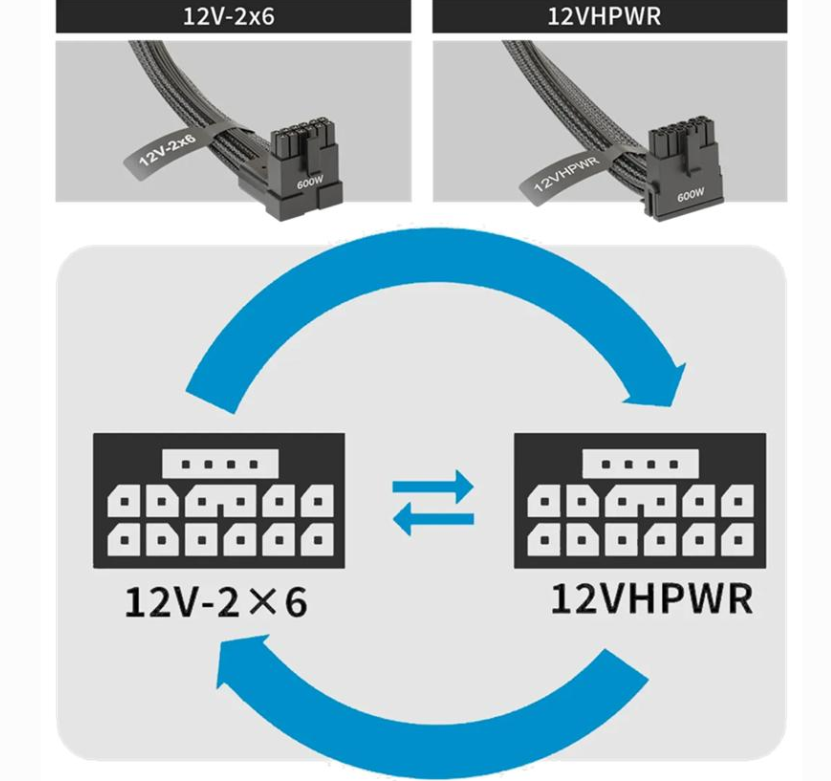
The single most impactful core difference between ATX 3.0 and ATX 3.1 lies in the native high-power GPU connector, engineered to eliminate widespread melting connector failures reported with early RTX 40-series graphics cards.
ATX 3.0: Original 12VHPWR (H+) Connector The initial 16-pin PCIe 5 connector uses identical-length power pins and sense detection pins. If the cable is partially plugged in (even slightly loose), the sense pins will still activate full 600W power delivery. Poor partial contact creates extreme electrical resistance, leading to heat buildup, scorched pins and melted plastic housings under heavy GPU load. Cable wire gauge minimum standard: 18 AWG internal wiring.
ATX 3.1: Revised 12V-2x6 (H++) Safety-First Connector PCI-SIG completely reworked pin geometry to add a mandatory safety interlock system:
Power pins extended by 0.25mm: 12V and ground terminals make full conductive contact before any signal pins engage
Sense pins shortened by 1.5mm: Detection pins only touch once the cable is fully seated. A loose partial connection cuts GPU power automatically to avoid thermal damage
Reinforced plastic housing, thicker internal 16 AWG wiring, and 45N locking retention force to prevent cable slipping inside the chassis
Tiered power communication logic: Limits power to 100W/300W if not fully locked, instead of default 600W full power output like ATX 3.0 units
Critical note: The two connectors remain physically cross-compatible. You can plug a 12VHPWR cable into an ATX 3.1 PSU, but the safety interlock feature will only activate when using native 12V-2x6 cables.
Hold-up time defines how long a PSU maintains stable DC power after a sudden wall AC power drop, a key metric for preventing crashes or corrupted files during brief power blips. This is a clear written spec difference between the two standards:
ATX 3.0 Mandatory Requirement: Minimum 17ms hold-up time at 100% full load
ATX 3.1 Mandatory Requirement: Minimum 12ms hold-up time at full load, with a recommended 17ms hold-up rating at 80% load for premium models
This adjustment is not a downgrade. The relaxed full-load threshold reduces unnecessary capacitor energy storage, slightly boosting light-load efficiency for 24/7 AI workstations. Top-tier ATX 3.1 PSUs still deliver 17ms+ hold-up performance in real-world testing, matching ATX 3.0 units.
Both standards retain the flagship 200% rated power transient tolerance for 100 microseconds — the core requirement to handle extreme GPU power spikes from PCIe 5 flagship graphics cards. However, ATX 3.1 adds stricter secondary voltage control rules:
Intermediate burst load voltage deviation cap tightened: ATX 3.0 allows ±5% rail fluctuation during 10ms power surges; ATX 3.1 restricts variation to only ±3% for smoother GPU power delivery during ray tracing or AI rendering spikes
12V rail ripple noise limits lowered: ATX 3.1 caps transient ripple below 30mV, versus the looser 120mV maximum threshold defined in ATX 3.0
Optimized overlapping spike handling: ATX 3.1 standardizes timing gaps between consecutive power bursts, reducing repetitive electrical stress on internal PSU capacitors for longer service life
ATX 3.1 introduces stricter idle power consumption rules to cut wasted energy for always-on workstations and office PCs:
ATX 3.0 baseline efficiency: Minimum 70% conversion efficiency at 20% light load
ATX 3.1 baseline efficiency: Raised to 72% minimum efficiency at 20% load
Standby power draw reduced: ATX 3.1 enforces <0.1W power drain when the PC is fully powered off, lower than the 0.2W limit allowed in ATX 3.0 specs
For creators running AI training tasks overnight, this incremental efficiency upgrade translates to measurable long-term electricity savings.
Intel revised startup timing and safety circuit trigger logic for ATX 3.1 PSUs:
Power-good signal delay (T1 boot timing):
ATX 3.0: Allowed up to 200ms POST delay
ATX 3.1: Capped at maximum 150ms for faster motherboard boot cycles
Refined over-power/over-current protection response: ATX 3.0 PSUs trigger hard instant shutdowns during minor overloads; ATX 3.1 protection circuits implement gradual power throttling first to avoid sudden system crashes that damage storage drives.
Uniform cross-rail current balancing rules for multi-rail PSUs: ATX 3.1 eliminates uneven power distribution risks for dual/triple GPU AI workstation setups.
To avoid misinformation, it’s critical to clarify all shared core specifications that remain identical across both standards:
Full 200% instantaneous power burst capacity for 100μs (the foundational ATX 3.x high-GPU power rule)
Full backward compatibility with all ATX 2.x motherboards, PCIe 3/4 GPUs, SATA, EPS CPU and legacy peripheral connectors
Mandatory six core safety protection circuits: OVP, UVP, OCP, OPP, SCP, OTP
Single 12V rail power allocation baseline (premium models support 100% total wattage on the 12V rail)
Maximum 600W single-cable power delivery limit for PCIe Gen 5 graphics cards
表格
| Comparison Item | ATX 3.0 PSU Standard | ATX 3.1 PSU Standard |
|---|---|---|
| GPU PCIe 5 Connector | 12VHPWR (H+), equal-length power/sense pins | 12V-2x6 (H++), safety interlock pin redesign |
| Full-Load Hold-Up Time | Minimum 17ms | Minimum 12ms (17ms recommended @80% load) |
| Low-Load Efficiency Baseline | 70% @20% load | 72% @20% load |
| Max Boot T1 Delay | 200ms | 150ms |
| Transient Voltage Fluctuation Limit | ±5% during short power spikes | ±3% tighter fluctuation control |
| Standby Off Power Limit | <0.2W | <0.1W |
| Core 200% Transient Power Support | ✅ Mandatory 100μs burst capacity | ✅ Retained identical requirement |
| Backward Hardware Compatibility | Full support for legacy PC hardware | Full backward compatibility retained |
✅ You plan to build a new rig with RTX 40 Super, RTX 50-series or AMD RX 8000 flagship GPUs
✅ You operate multi-GPU AI workstations running 24/7 rendering/model training
✅ You want maximum long-term hardware safety and eliminate connector melting risks
✅ You prioritize lower idle power consumption and faster system boot speeds
✅ You are building a future-proof PC that will upgrade GPUs for the next 3–5 years
❌ You own a mid-range RTX 40-series GPU (under 300W TDP) and do not plan future upgrades
❌ You have a budget office/gaming PC with single mid-tier graphics card
❌ You already own a certified ATX 3.0 unit with zero connector heating issues during long-term use
Yes, physical compatibility is fully supported. However, the older 12VHPWR cable lacks the safety pin geometry of native 12V-2x6 wiring, so the partial-connection power lock safety feature will not activate. Native ATX 3.1 cables are recommended for full safety protection.
No, wattage sizing formulas stay identical. The ATX 3.1 standard only improves safety, efficiency and voltage stability — it does not increase minimum power requirements for any GPU or CPU model.
Not entirely. ATX 3.0 still delivers stable performance for mid-range PCIe 5 GPUs, but ATX 3.1 is the updated industry standard for all new flagship PC builds, primarily due to its game-changing connector safety redesign.
The core differences separating ATX 3.0 and ATX 3.1 power supplies revolve around enhanced hardware safety, tighter electrical regulation and optimized energy efficiency, while both standards share the same critical 200% transient power tolerance required for modern PCIe Gen 5 graphics cards. The redesigned 12V-2x6 connector is the most valuable upgrade, solving the dangerous partial-seat melting flaw that plagued early ATX 3.0 hardware.
For anyone assembling a new high-end gaming PC or multi-GPU AI workstation, ATX 3.1 compliant power supplies deliver superior long-term reliability and safety. Our factory produces a full lineup of fully certified ATX 3.0 and ATX 3.1 PSUs ranging from 550W up to 1600W, with flexible OEM & ODM customization for global gaming brands, system integrators and AI workstation manufacturers. We offer complete single-rail 12V output models and native 12V-2x6 connector variants fully compliant with the latest ATX 3.1 industry specifications.


